ONCE UPON A TIME IN MATH
A Sputnik-era plan to teach kids advanced mathematics quietly lives on
Vered Zimmerman
February 2026
1.
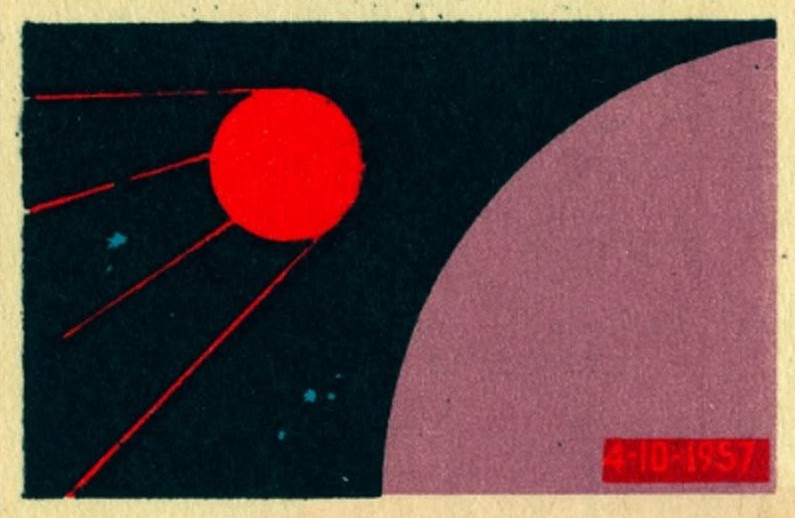
The Russians placed Sputnik 1 in orbit on October 4, 1957, making sure everyone could hear it. The rocket sending it up there had the range to reach America, but this was almost an aside. What mattered more was that the Soviets had made space theirs, and the Americans did not. Invisible in the night’s sky, the United States could nonetheless feel it, looking down, mocking.
2.
I used to go back and stop time, right before math class on the first week of middle school. In the hall, young children are frozen in motion, scrambling to get into rooms. I would lean against a wall and gaze at twelve-year-old me. To her, this new school seems huge. Some of the older kids look like adults, how is that even possible. She wonders if she counts as chubby.
Knowing what’s about to happen, I used to look at her and think about choices and luck. Other times, I would try to glimpse nature from nurture. Until, one day, she slowly turns her head and looks back at me, worried. “Leave me alone,” she says, “it’s class now.” So that day I walked away from her for the last time.
3.
Even before Sputnik, the US was concerned its math education was too uneven, too aimless. In 1950 the Americans set up the National Science Foundation (NSF), to invest in science research and education. In 1955, the College Entrance Examination Board appointed a special commission to suggest changes to how math is taught in high school, so students arrive at university better prepared.
The trouble was, math had progressed as rapidly as any of the other sciences, but school kids were still being taught the best and the finest of seventeenth-century wisdom. Math education rarely grabs headlines, but suddenly it was the space age.
4.
The five-year period that ushered in the American "New Math" era reads very much like an Agatha Christie mystery. Among the characters are:
- The savvy academic, Ed Begle. He’s the director of the School Mathematics Study Group (SMSG). It was launched in 1958 by the American Mathematical Society and funded by the NSF, to spur new textbooks and curricula for K-12 math education.
- The diplomat, Howard Franklin Fehr. A prolific math-education scholar and the head of the mathematics department at Teachers College, New York.
- The eccentric Frenchman, Jean Dieudonné.
It’s 1959, and the Americans are all staring down fabulous wealth, so to speak. The NSF annual budget has just been tripled, to $134 million, with an urgent mission to do something about science education. Within a decade, it’ll grow to $500 million per year.
They and others gather in a countryside abbey at Royaumont, France, and a murder is announced. The Frenchman, Dieudonné, rises to give his speech and calls out: “Down with Euclid! Death to Triangles!”
Dieudonné’s fury was over the months and years schools devote to Euclidean geometry. It has axioms – basic principles assumed to be true, from which all else must follow. One axiom looks dodgy, like you could prove it from the others. For two millennia, people have tried and failed. But dropping it makes geometry seemingly nonsensical, so it remained an axiom.
Alas, from at least the early nineteenth century it was known many other geometries exist, some just as physical, where this axiom just isn’t true. It was outrageous, said Dieudonné, to keep teaching kids “geometry” without ever teaching geometry. To add insult to injury, most school math is grounded in procedural calculations; the only time pupils ever learn to prove anything is in geometry…
Howard Fehr had prepared the final Rayoumond report, published in 1961. There, Dieudonné’s remarks appear as “Euclid must go!”, and it remains the conference’s most cited moment. Other common themes in talks were the urgent need to build reasoning and abstraction skills.
A set of guidelines on how to do it came in the form of a report, “Goals for School Mathematics”, with ideas hashed out by Begle and top-tier mathematicians in a 1963 gathering at Cambridge, Mass. This report laid the foundation for the New Math wave in the US.
5.
New Math is remembered as a failed experiment, a bad relationship. As often happens in breakups, this retelling excludes the honeymoon period, when America fell madly in love with math. Starting in the late 50s, pop culture couldn’t get enough.
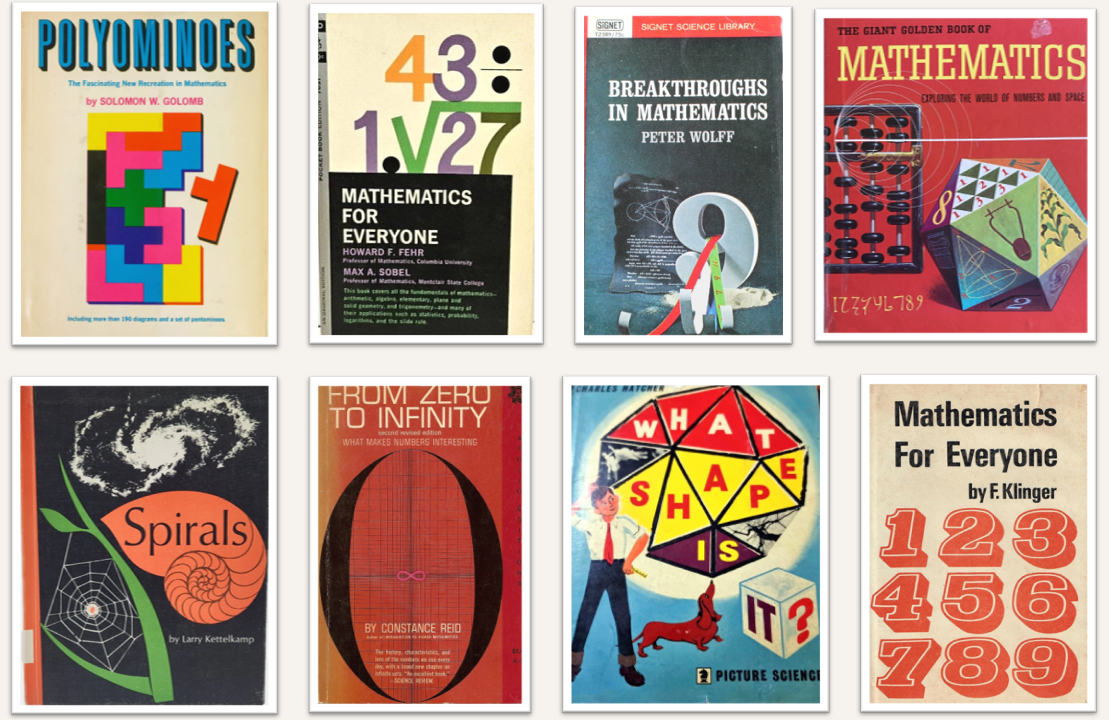
For reading material, candy-coloured book covers pitched math as hot and cool.
At the movies, Disney got an Oscar nod for "Mathmagicland", where a spirit guides Donald Duck through a technicolour "wonderland of mathematics.” Four years later, "The Dot and the Line: A Romance in Lower Mathematics" won the award in the short film category.
Or you could just watch TV. For adults, NBC produced “The Bedrock of Logical Thought”, a ten-part math talk show(!) For teens, Westinghouse made the nine-part “Adventures in Numbers and Space” (advised by Howard Fehr). The TV guide printed listings like “Bil Baird and his puppets discuss topology and Euler's theorem”, and everyone thought this was normal.
6.
Improbably, the era’s math frenzy also gave us "The Very Hungry Caterpillar". This toddler staple has been munching its way through tens of millions of copies since 1969.
It was written and drawn by Eric Carle. In the official telling, it is the third picture book Carle had illustrated. The second was also his. And the first one comes with lore:
Supposedly, Carle was working as an illustrator at an advertising agency. One day, a children’s book author sees an ad with a bright red lobster. Besotted, he seeks out Carle to illustrate his new book “Brown Bear, Brown Bear, What Do You see?”. It gets published in ‘67 and becomes a smash hit.
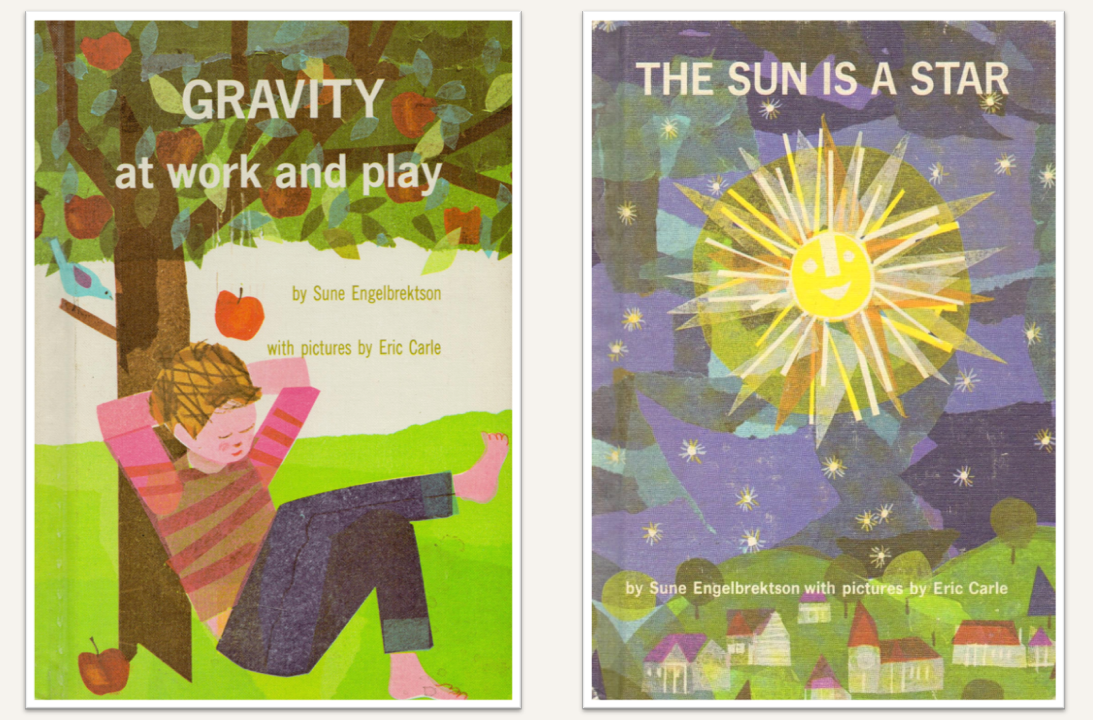
This wonderful Cinderella story is dented only by the fact it’s untrue. In the spirit of the age, Carle got his entry into children’s books in the early sixties, via nursery physics.
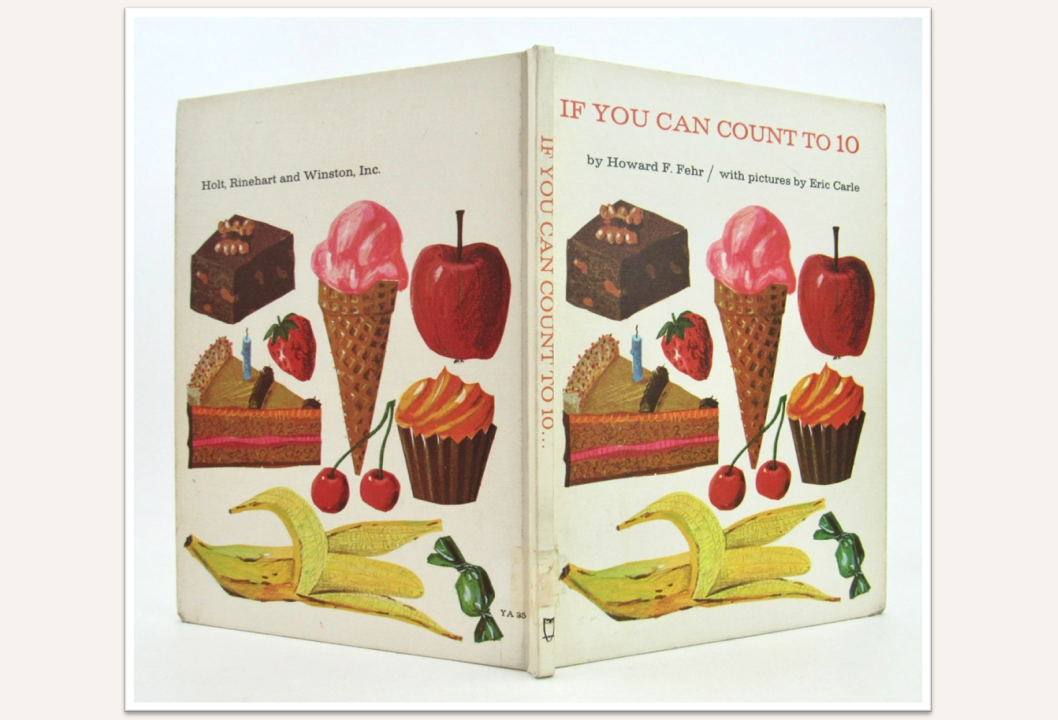
He then found greener pastures in counting, illustrating for none other than Howard Fehr. It’s not hard to see in these books an early version of the items the caterpillar eats his way through.
7.
Our fingers are good for many things, including telling us that 5 plus 5 are 10. But equally, if today is a Thursday, and someone asks us what day it will be in five days’ time, we will tell them it’s a Tuesday. In week-counting, 5 plus 5 comes out as 3.
Say someone wakes you up at 3am, and asks you what time it will be today in 22 hours. Rubbing your eyes, you say it will be 1am tomorrow morning. This enrages your visitor: who asked about tomorrow?! They want to know what time will it be to-day.
It’s not going to be today, you explain, because a day moves in circles of 24 hours, just like the week moves in circles of 7 days, and our years move in 52 weeks, which are 12 months. We add numbers round and round and think nothing of it.
7, 12, 24, 52, 365. Wouldn’t you say these numbers are a bit…arbitrary? If you can add round and round, why not do it round any number? If anything, this would be more natural, as it keeps all numbers on equal footing. This was called “clock arithmetic”, and was the very first thing taught in middle school.
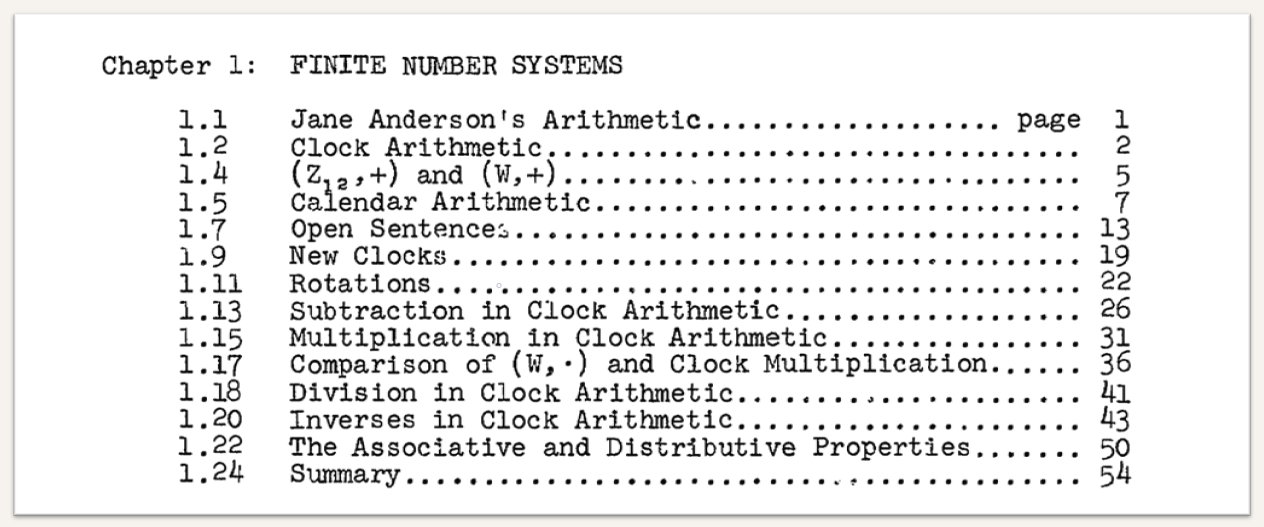
For, when time restarts and I go into class, the teacher tells us we will be following a different course of study than the other classes. Ours is called “The Columbia Program”, specially developed at Columbia University, for gifted pupils. She could have said Mars, it would have made no difference. We were handed stapled booklets made of photocopies of typewritten Hebrew text. They looked ancient.
But clock arithmetic was harmless. Soon enough, 2 plus 2 is no longer so obviously 4. In a 3-clock, it is 1. In a 4-clock, it is zero. The arithmetic is easy and kind of fun.
And subtly, imperceptibly, we learn our first lesson: numbers are not absolute. Adding ‘5’ works differently not just depending on whether it’s a finger or a day; before you can say how much adding ‘5’ is, you have to understand where ‘5’ lives.
8.
It’s ironic how, in its bid for space victory, what America felt it needed was the French. But, at a time when all ills were due to old math, they had one name in mind: Nicolas Bourbaki.
Bourbaki was the given name for a collective of French mathematicians. One of its founding members was Dieudonné, he who had wished so ill upon Euclid.
See, there really was a lot of new math. Much of it had originated in Germany in the late nineteenth and early twentieth century. Radical discoveries framed a new view of mathematics, as a unified field. There was no longer this kind or that kind of math; it was all one. Bourbaki would talk about their field as Mathematic. Single, not plural.
Sadly, France’s math departments told of another new reality. The Germans had exempted their mathematicians from frontline service during the first world war, but not the French. This did away with an entire generation of math scholars, leaving French textbooks behind. Bourbaki planned an ambitious series of new books, with the whole of mathematics written anew in its modern form. The first six volumes, covering most of the chart below, were published by 1955.
The chart shows how Bourbaki organised the unity of modern math, and certain features immediately jump out. For one, it is a hierarchy. Things at the bottom are considered more fundamental than ones higher up. This specific hierarchy was absolutely not embraced by all mathematicians, especially ones whose field wasn’t even in it.
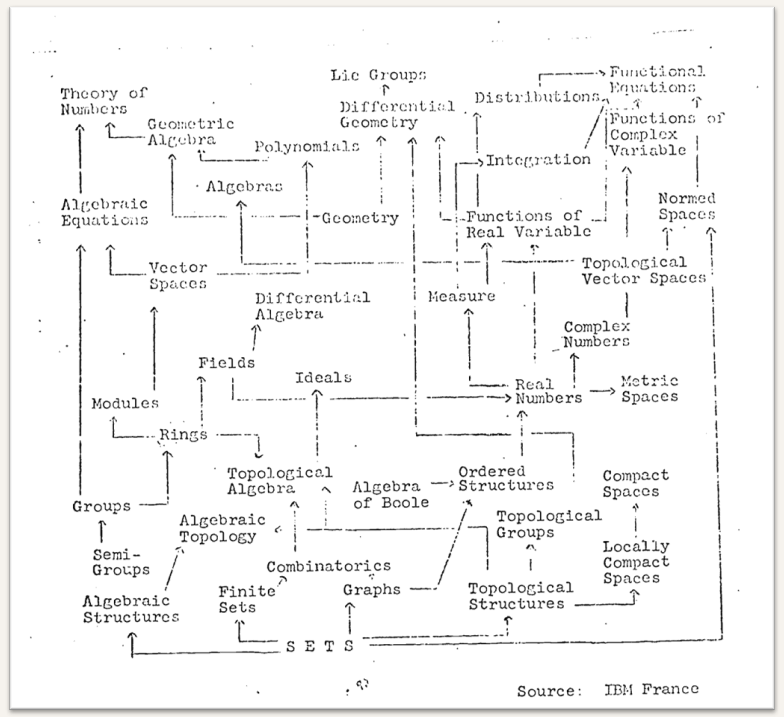
Also, notice ‘Geometry’ hovering around the middle at the very top, entirely disconnected from anything below. This view enraged a sizable cohort of mathematicians. Historically, math mostly starts with the ancient Greek, who liked to measure. To the extent we’ve learned anything since, the critics said, much of it must surely flow from geometry.
Three, a patient observer will notice ‘Groups’ appearing thrice in this chart. Imagine turning the chart on its side, either to the left or to the right, so other parts now become the foundation. You’d still run into groups in no time.
But if groups matter so much, why has no one ever taught them in school? In the sixties, education reformers were asking much the same. Of course, no topic is taught to full accuracy early on. But they worried math had changed to the point where standard curricula may actually hinder scientific progress.
Take a final look at this chart. It’s how undergrad math degrees are universally taught today. Of all French exports, it can be argued the most successful was neither the croissant nor champagne, but how to think about math.
9.
TIME Magazine
December 2, 1957
“Professor Howard Fehr, head of the mathematics department at Columbia Teachers College, is generally an amiable man. but he can become blunt when talking about the abuse his subject takes in the average U.S. school. “The mathematical education of most math teachers,” says he, “ends in the ninth grade.” They teach arithmetic as if it involved nothing more than totting up grocery bills or figuring compound interest, completely fail to give their pupils any glimpse into the concepts that lie behind the subject.”
Columbia Teachers College. Did I mention Teachers College has been affiliated with Columbia University since 1891?
10.
Evidently, Fehr was a gifted project manager. Books and TV shows; papers and conferences; speeches and admin; these were all mere side hustles compared to the “Secondary School Mathematics Curriculum Improvement Study” (SSMCIS). It was the pinnacle of his career, stretching from ‘65 to ‘76, when the money ran out.
Imagine an ant walking the spiralling wire of a slinky. It’s moving forward, but also keeps returning to the same place, only now a rung up. Its local position looks similar to last time, but the ant is now a bit wiser, having completed the slinky circumference.
The textbook series was called “Unified Modern Mathematics” and did what it says on the tin. The foundations were wholly Bourbaki: sets, relations, structure, and structure-preserving mappings. Like the ant walking the slinky, the plan spiralled. Year to year, it would cover the same concepts, at growing depth.
Fehr had observed how New Math rollouts had faltered and wasn’t about to repeat mistakes. The list of stakeholder-groups alone reads like the planning of a high-stakes caper:
* The first group is mathematicians and educators, who advise on topics;
* The second is more mathematicians and educators, who develop the syllabus;
* A third, the writers;
* A fourth, research assistants and typists;
* The fifth, classroom teachers;
* The sixth, classroom students;
* And the seventh, observers, to observe the teachers and the students.
11.
For us there was no “New Math”, there was just math. Whether she knew or not, our eighth-grade math teacher was disliked for her impossible tests. In practice, she was a competent teacher entrusted with tough material.
Recall Euclidean geometry, so detested by Bourbaki for its overly narrow scope, which turns the act of proving into a pointless game. In Columbia, every bit of math involved proofs.
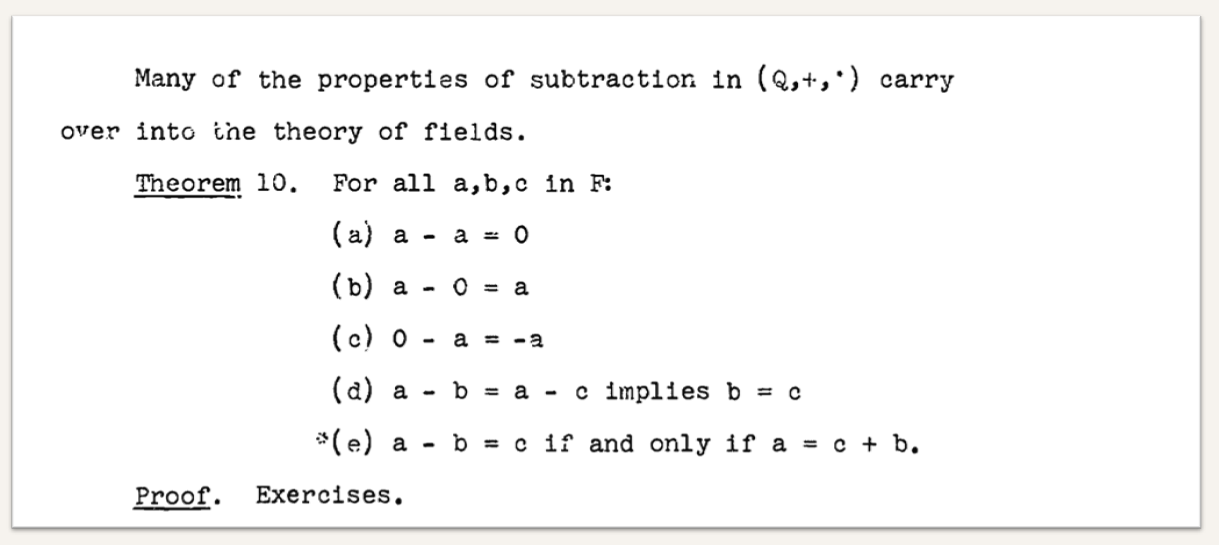
There was also geometry, but not as you know it. The starting point is similar: one assumes a bare minimum of reasonable axioms, including (after much caveating) the troublesome Euclidean one, and proves some of what must follow.
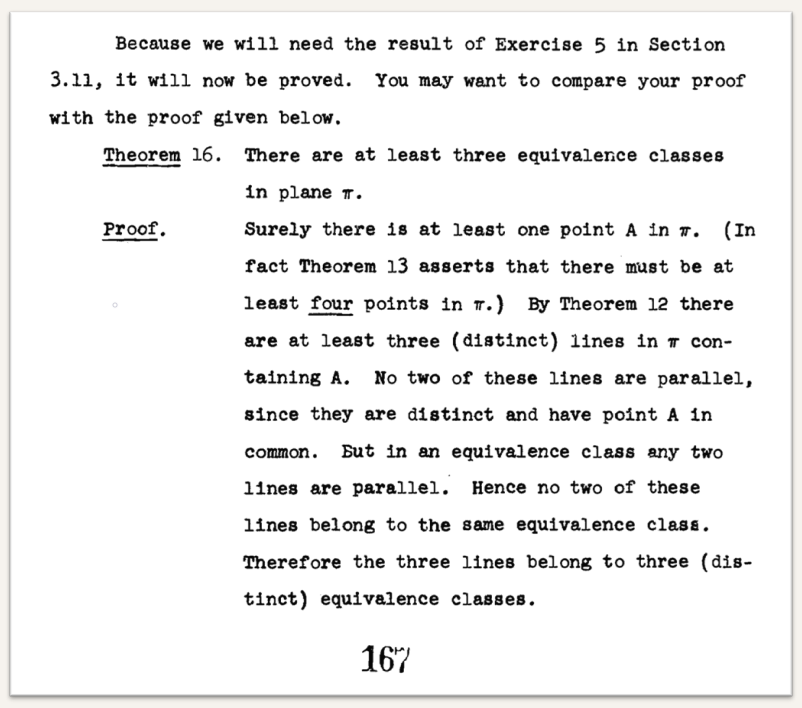
But all these are mere preliminaries to the real goal, which was studying transformations. In this view, geometry is what happens when things get moved around.
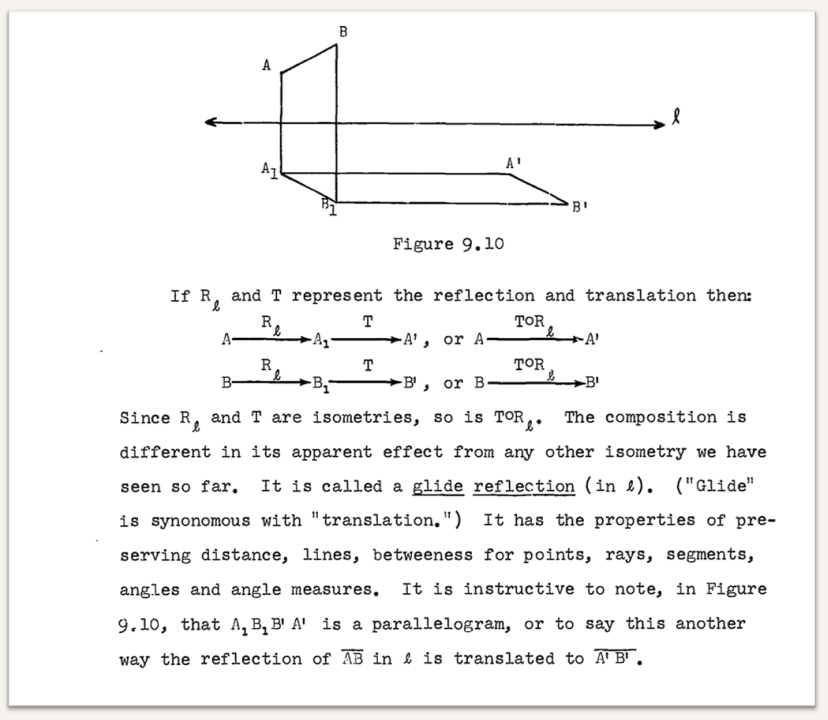
That escalated quickly, didn’t it? Proving felt perilous and doomed, like navigating the open ocean in a leaky boat. I was now thirteen, and felt soot-black shame at how much I was struggling with math. No one likes to feel dumb.
12.
By the early seventies, America at large was feeling great. It had won. It had put a man on the moon, and its scientific prowess was rivalled by none.
Meanwhile, New Math hadn’t spread quite as evenly as is now remembered. But it did reach enough communities where children’s math books confused not just parents, but teachers as well. The zeitgeist was captured in 1973 by “Why Johnny Can’t Add”, a sneering, compact book, which ridiculed arrogant academics telling teachers how to do their job.
This manifesto was written by Morris Kline, himself a mathematician. He thought pushing abstract maths onto children was misguided. He also objected to the Bourbaki mapping of the terrain. In later years Kline turned to publicly mock how undergraduate math gets taught, and from there, to lambast mathematical research itself. For someone who had devoted their life to math, he doesn’t seem to have liked it very much.
In the end, even with all that money, US educators just couldn’t bring New Math to everyone. Nature. Nurture. Luck. Choice. Round and round it goes.
13.
When tiger cubs playfully pounce each other in nature shows, a voiceover murmurs they are practicing their hunting skills. This is both true and false; skills are being practiced, but the cubs are clearly having fun.
The Columbia books were meticulously exact, and we learned mathematical ideas are expressed with the careful use of words in very particular cadences.
We liked their air of punchy authority, and expressions started filtering into everyday speak. To discuss Metallica’s changing style, an album track could be chosen “without loss of generality”. Our eyesight got no better, but assertions became “easy to see”. Smoking may have been lame, but shoulder pads were lame “by definition”.
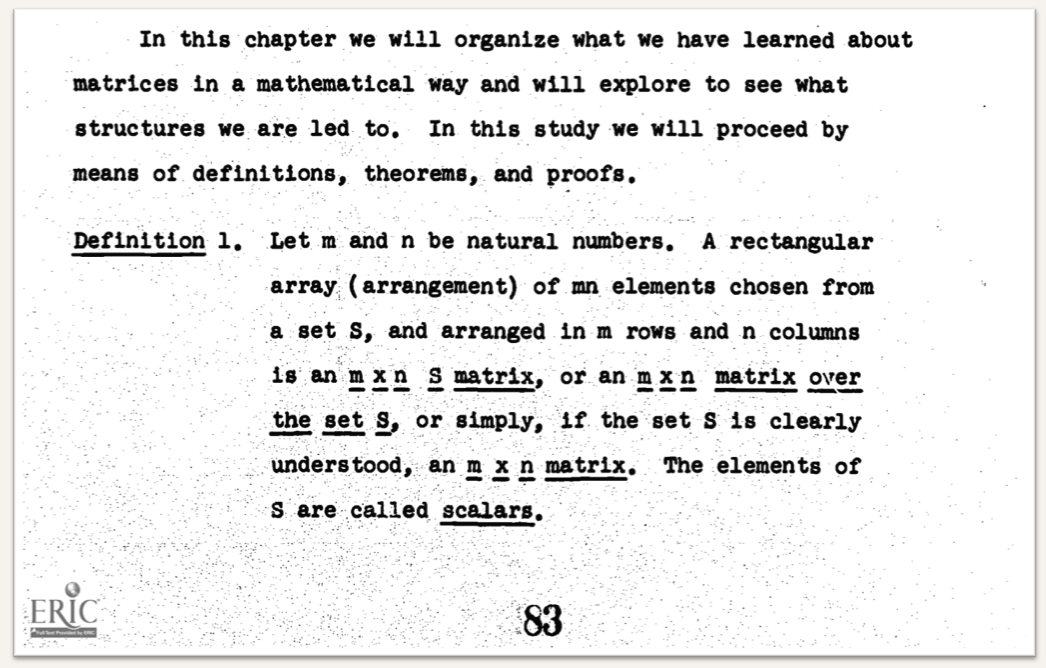
Math wasn’t always written so rigidly, and critics like Kline believed teaching this way stifles children’s creativity, with style obscuring how math gets done. But this was a red herring; even the most ardent supporters of this form have always explicitly said that ‘doing math’ was a two-step affair.
People take different routes to solving a problem: one might draw a picture; another tries out examples in search of a pattern; a third might try tweaking a previous logical chain. Whichever, it helps when everyone writes out their proofs in the same, crystal-clear way.
You could hear when you were doing it wrong. Until, with practice, you begin to experience the pleasure of getting it right. The final result sits on the page like a tiny origami swan, all clean lines and economy of construction. A universal truth that, somehow, belongs only to you.
14.
One year, our class had a special school trip, where we would be joined by two other gifted classes from different cities. It really didn’t take long until someone popped the question: how are you guys finding Columbia?
Columbi-who? Neither class had any idea what we were asking. Yes, of course they studied math. Yes, of course it was like the other kids in school. What do you mean different? What kind of other math is there?
In time we learned we were alone. In the whole of the country, just one class per cohort flowed through the program. But why us? What did we ever do to Columbia University?
No one could tell.
15.
Hunter College, New York, is an elite school with a building shaped like an armoury and an admissions record to match. It boasts that its twelve hundred students – thirty percent fewer than it was educating in 1878 - "represent the top one-quarter of one percent of students in New York City”.
Once you start playing the elite game, why stop? To this end, math remains an effective cudgel. Beginning in the eighth grade, Hunter College offers two Honors programs: Honors and Extended Honors. That last one comes with menacing overtones:
“The Extended Honors Program was originally based on the Secondary School Mathematics Curriculum Improvement Study (SSMCIS) Program. It includes many advanced topics and requires extensive preparation and a considerable commitment of time to the study of mathematics.”
16.
From the SSMCIS final report submitted to the National Science Foundation:
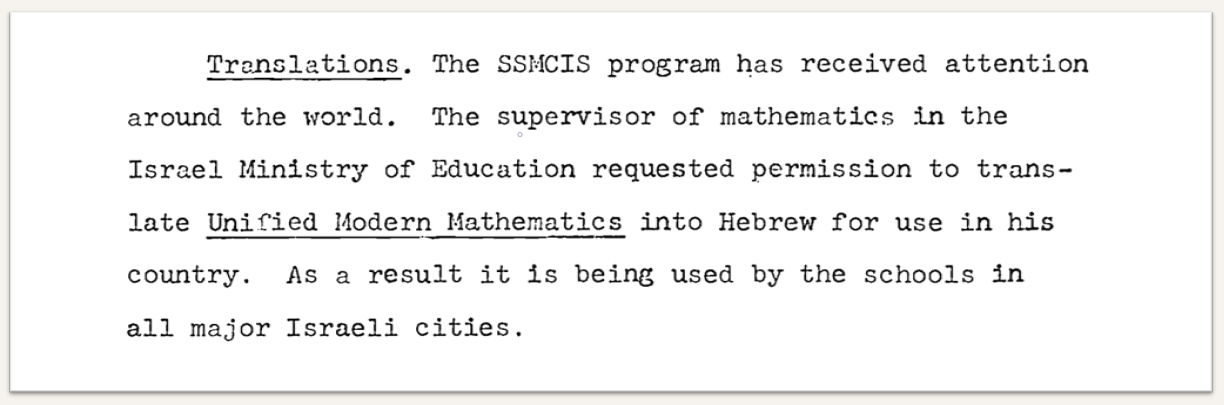
Here’s how this came about.
In the late sixties Asher Marcus was the national superintendent of mathematics at the Israeli Ministry of Education. He was well aware of the change spreading across the US and Europe. From 1959, US initiatives had access to incredible funding, so their progress was closely followed. And Fehr was ever-present in journals and at international conferences.
While Fehr’s program was only ever meant for the top twenty percent, Marcus intended to roll it out nationwide, so all children in Israel would be educated this way. After all, this was clearly the future.
But young Israeli kids couldn’t read English. Marcus was a very close friend of Akiva Skidell, a math educator who was born in Poland, raised in Canada (where he studied math), and served in the US military (where he was among the troops first arriving at Buchenwald concentration camp). Skidell had already co-authored a New Math textbook himself.
Together with Fehr, early on they agreed Skidell would translate the books. The final version of the first SSMCIS book was published in 1968; a year later, its Hebrew version followed.
17.
Marcus decided to launch the program with a pilot, for which he would personally select two teachers, from two different schools. He set the pilot in Haifa, the largest metropolitan in Northern Israel. Haifa’s strongest school was the private Hebrew Reali School. It had a renowned math teacher, Benjamin Maier, with whom Marcus had already worked on recording TV math lessons for the public broadcaster. He was a natural choice.
The second teacher was a young woman named Nitsa Movshovitz-Hadar, who herself had been a student of Maier’s only a few years prior. She then studied math and physics at the Hebrew University in Jerusalem, where she also got a teacher’s diploma, and went on to teach. She was now teaching at a public school, and nervous about having the national superintendent himself watch her class. She got picked.
In the summer of 1971 the two spent six weeks in New York, attending Fehr’s teacher-training course. Upon their return, each set out to train their colleagues. This wasn’t a problem because, at the time, a bachelor’s degree in mathematics was a prerequisite for teaching math in schools. The teachers easily understood the material. But could they teach it to an entire student body?
“Oh, we all loved it,” she says. “I would leave each class floating with joy.“
The problems, she adds, were never about student competence. Rather, the program was designed for five weekly math lessons, whereas the national allocation only offered four. Therefore, each year would fall short of completing the material, which created problems the following year. There was also the question of continuity. The SSMCIS middle-school material didn’t align with the existing senior-school plan, and Fehr’s team was still writing those latter books.
But for Movshovitz-Hadar it was a life-changing experience. New York had made such an impression, she was resolved to spend more time in the States. Within a year she was accepted to a PhD in Berkely, California. With her husband and two young children, she set off on an adventure. Four years later she returned to Israel and became a math-education professor, eventually also serving as the director of the Israel National Museum of Science.
By the mid-70s, Columbia had been moved to a different school, and was being taught only to the city’s gifted class. But the Ministry of Education continued translating the middle-school textbooks, presumably for wider use. Skidell’s translated versions of the second- and third- year books were published in 1974 and 1975 respectively.
18.
It was the mid '90s and we were about to start high school. Suddenly there was a choice: after three years of compulsory study, pupils could opt out of Columbia, and do whatever everyone else did.
Columbia offered no extra credit. The final marks would be the scores on internal finals instead of the national exams. (As was the case with the original SSMCIS.) Why take the extra hardship for mostly downside risk? Half the class quit in a heartbeat.
For the other half, by then we kind of got the hang of Columbia. Leaving would mean getting used to a new system and who wants that. Also, quitting was unfathomable.
19.
Looking back, you didn’t need Columbia to do well at university, though it sure didn’t hurt. The payoff was in how old things connected, and how new things weren’t too hard.
For example, it covered much of first-year undergrad calculus at a comfortable pace. All of science lives atop this stuff, but at undergrad pace the material can come as a shock: notions of infinity coexisting with proximity; Greek letters playing very specific roles; tricky proofs. Columbia stretched it out.
Also, and this I only understood later in life, the means are the end. For three years, we were taught by a very, very good teacher.
20.
When Marcus chose Haifa as his New Math epicentre, he likely didn’t care that the city happens to be a university town. After all, his was the business of teaching math to kids; what they do once they get to university – typically in their early twenties, after several years of national service – was somebody else’s problem. One afternoon, I became somebody else’s problem.
At the start of my junior year of high school I decided to take academic math courses at the Technion (the Israeli Institute of Technology), and now had to face the single qualifying hurdle: meeting an actual mathematician. I was wary of what he might ask – math riddles? difficult computations? – but was assured it would just be a friendly chat. Mostly, he wanted to know I was choosing this out of my own volition. With this cleared, he said they recommend starting with “Set Theory”.
I was high on success. No more having just any old homework; I was good enough to have grownup homework. The cost for the whole term, with academic credits, came to about thirty hours of teenage minimum wage. (My parents paid.)
There were twenty-one students taking the class that term, four of whom were kids; I wasn’t even the youngest. There was an older girl from my school (also in Columbia), and two boys from elsewhere. In the tiniest of classrooms, we earnestly packed the front row. Into the room came a chuckling math professor, visibly amused with his crowd. Throughout the term, he graciously treated us no different to any of the other students.
The material laid out had the elegance of spring dew. We saw how infinity was not one thing, and how to show one infinity is bigger than another. This time easily ranks among my top five life experiences. It was good funnelling: at least three of those kids later chose a math degree.
21.
Back then, such academic forays were tolerated but not encouraged. Also, no one fussed. The academic credits were meagre, as I was only doing a course per term. I was lucky to have friends who thought being curious was cool. Since many of them were in Columbia too, they accepted the premise of depth and joy, even when math wasn’t their thing.
Times have changed. The Technion now offers several structured programs to bring in ambitious teenagers into academics early. They dangle real carrots, like swapping STEM finals for marks on academic coursework.
There is also the ‘Bar Ilan plan’ (read: Bar-eelan, so named after a different Israeli university). This one pushes kids to complete their math finals by tenth grade. It frees two years of math time, which can be used for undergrad studies. These setups are all selective.
For Columbia, which had quietly survived for five decades, it meant stiff competition. Once given a choice, kids who would otherwise stay now opt out, to partake in a benefit-carrying program. Left are only a handful of pupils, too few to warrant the investment. For the past two years, the school let the program lapse.
22.
In the US, the end of New Math did not spell better results in standardised math tests. As new reforms came and went, the era left a hollow yearning for the onetime alacrity to aim high. Ever since, educators periodically try to whip some of that magic by calling for a ‘new Sputnik moment’.
But to do what? School math is taught so it can be used to calculate, test, compare, affirm, gain entry, tick a box, socialise, screen, build resilience, earn status, split tabs and pay taxes. Past all this, once in a blue moon, it turns funny.
23.
You know, it was the smallest thing. Two years into my math undergrad, in a spring term final. A question was asking to prove a statement, specifically testing our use of a certain mathematical hammer. The standard proof would involve a splitting into a number of cases and ruling each out as impossible, until the only one left was the desired result.
It was a topic I liked, and had independently read a little further along, enough to be aware of an object that must always exist. All I did was ask, “Well, how big is this thing here anyways?”
In a flash, right there and then, the whole problem collapsed.
Instead of a series of niggly cases, this little tug instantly showed there could never be anything but the desired result. What’s more, the question had specific numbers in it, whereas this showed a more sweeping, generalised truth.
The sheer surprise of it hit me in the gut with force. Before I knew it my eyes swelled with tears. I felt an urgent need to walk and breathe. I took a bathroom break to step outside. Circling the hall, I turned the argument in my mind, this way and that, looking for flaws. Then I went back in and wrote it down, all five lines of it.
In my years in math, this was not my cleverest, nor loveliest, nor most complex or sophisticated proof. It was a wispy little thing. But on this one time I got to feel what it's like, to be punched by beauty.